
Mount a Backblaze B2 bucket in Finder on a Mac
A Backblaze B2 bucket can appear in the Finder sidebar beside your drives. This guide sets that up with BucketVolume.
What you need
- A Mac and BucketVolume from the Mac App Store.
- A Backblaze account with a B2 bucket.
Steps
-
Create an application key in Backblaze
In the Backblaze web console, open Application Keys and add a new application key. The key can be limited to one bucket.
Backblaze shows a keyID and an applicationKey once. Note the region shown with the key as well, for example
us-west-004. -
Connect the bucket in BucketVolume
Open BucketVolume and choose Connect a Bucket. The sheet has two steps.
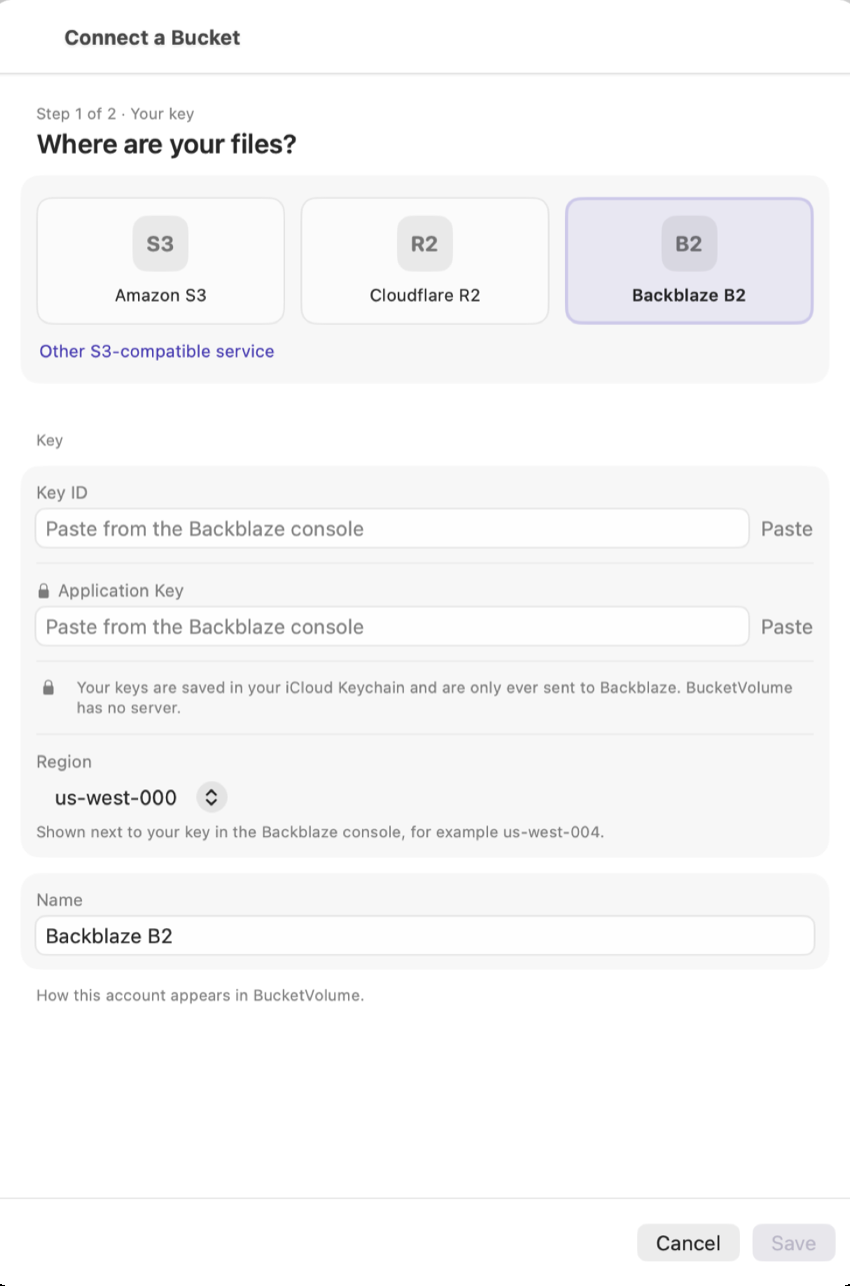
Step 1 asks for the key. Choose Backblaze B2 from the row of providers. Paste the keyID into Key ID and the applicationKey into Application Key. Set Region to the key's region, and choose Save.
A Backblaze key works in one region only. If Backblaze does not recognize the key in the region you chose, BucketVolume tries the other Backblaze regions it knows and switches Region to the one that accepts the key.
Step 2 asks Which bucket? Pick the bucket from the list, or type its name in the Bucket field when the key cannot list buckets.
If BucketVolume already has a credential, use the + menu instead: Add Credential… opens the same two steps for a new key, and Add Bucket… adds a bucket with a key BucketVolume already has. A second credential or a second bucket needs the Pro upgrade, and BucketVolume offers Pro at that point.
-
Open the bucket in Finder
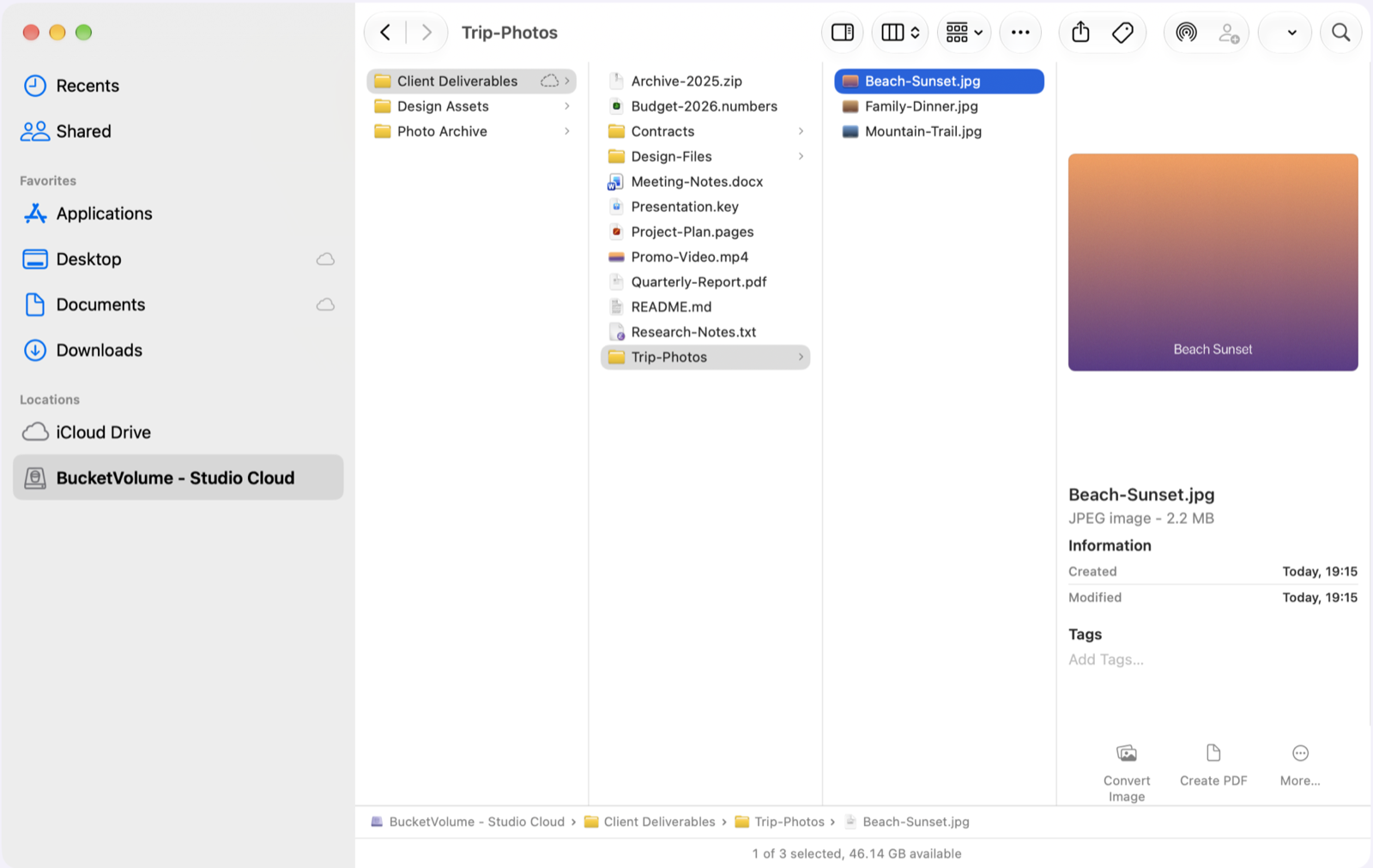
Open a Finder window. BucketVolume is in the sidebar under Locations, and the bucket is a folder inside it.
Files open in any Mac app, and saving a file uploads it to B2. Drag files in and out as you would with any folder.
Good to know
- A file downloads when you open it, so a large bucket does not fill the Mac's disk.
- The B2 credential syncs to your iPhone and iPad through iCloud Keychain. Add the bucket on each device where you want it.
- If the bucket changes while you are editing a file, BucketVolume keeps both versions and names yours as a conflict copy.
- BucketVolume has no server. The key goes only to Backblaze.


BucketVolume costs $2.99 once, for iPhone, iPad and Mac together, and includes one credential and one bucket. The optional Pro upgrade, $9.99 once, raises that to 100 credentials and 1,000 buckets.
Other guides
- Mount an Amazon S3 bucket in Finder on a MacAn Amazon S3 bucket can be a folder in the Finder sidebar. This guide sets that up with BucketVolume.
- Mount a Cloudflare R2 bucket in Finder on a MacA Cloudflare R2 bucket can sit in the Finder sidebar like a drive. This guide sets that up with BucketVolume.
- Open an Amazon S3 bucket in the Files app on iPhoneAn Amazon S3 bucket can appear in the iPhone Files app under Locations. This guide sets that up with BucketVolume.
- Open a Cloudflare R2 bucket in the Files app on iPhoneA Cloudflare R2 bucket can be a folder in the iPhone Files app. This guide sets that up with BucketVolume.
- Open a Backblaze B2 bucket in the Files app on iPhoneA Backblaze B2 bucket can appear in the iPhone Files app next to iCloud Drive. This guide sets that up with BucketVolume.
- Open an Amazon S3 bucket on iPadAn Amazon S3 bucket can appear in the iPad Files app as a folder. This guide sets that up with BucketVolume.
- Open a Cloudflare R2 bucket on iPadA Cloudflare R2 bucket can sit in the sidebar of the iPad Files app. This guide sets that up with BucketVolume.
- Open a Backblaze B2 bucket on iPadA Backblaze B2 bucket can appear in the iPad Files app beside iCloud Drive. This guide sets that up with BucketVolume.